Sparks behind the waveguide cover, a hum with no heat, or a unit that keeps running after you open the door: one call to Acdc Appliance Repair connects you with a licensed, insured independent microwave pro near Weedpatch who works on over-the-range, built-in and drawer models.
A microwave is not a toaster. Inside the cabinet sits a high-voltage capacitor that can hold a lethal charge long after the plug is pulled, which is why this repair belongs with a trained technician and never with a screwdriver and a video.
Why Callers Use Our Network for Microwave Repair in Weedpatch, CA
Acdc Appliance Repair is a free referral service. Our dispatchers listen to the symptom, then route the call to an independent local pro who handles microwave electronics and mounting work.
Licensed and insured independent pros
The contractors in our network are independent businesses that carry the license and insurance local rules require. Ask to see both at the door.
Upfront written quotes from the pro
A magnetron or control board for a built-in can be a real expense. The technician writes the quote before any work starts, so you can compare it to a replacement unit and decide.
Rapid local dispatch
Calls go to an independent technician whose route runs close to Weedpatch. If the route has room, a pro can frequently reach you that same day, and you get the arrival window before the call wraps up.
High-voltage tools and know-how
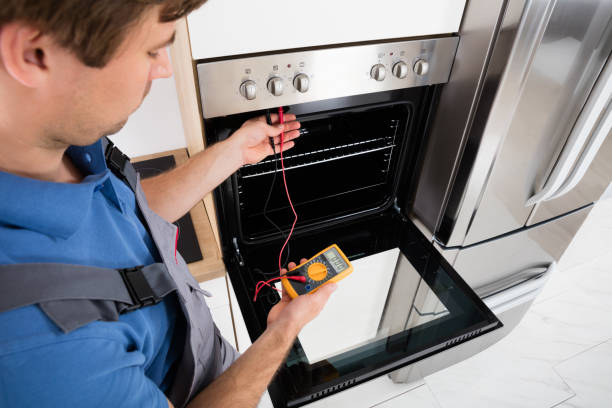
Expect an insulated discharge tool for the capacitor, a multimeter for diode and transformer checks, the model tech sheet, and a microwave survey meter to check for leakage after high-voltage work.
What gets fixed
Microwave Repairs the Pros Handle
These cover the over-the-range, built-in wall, drawer and convection combo models that are worth repairing. Each starts with a safe capacitor discharge before any testing.
No heat
Hums but Does Not Heat
Everything seems to run except the heating. That points to the high-voltage circuit: a failed magnetron, a shorted diode, an open capacitor, or a burnt transformer winding. The pro checks each part with a meter after bleeding the stored charge.
Magnetron filament and insulation tests
Diode and capacitor checks
Transformer primary and secondary readings
Sparks
Arcing and Sparks Inside the Cavity
Sparking inside the oven often traces to a food-soaked waveguide cover, bare metal where the cavity paint chipped, or a worn rack support in a combo unit. Ignoring it can scorch the cavity and kill the magnetron.
Waveguide cover replacement
Cavity paint and rack support inspection
Stirrer and antenna check
Door switches
Dead Unit or Runs With the Door Open
The door has several interlock switches and a monitor switch that blows the line fuse if the others fail. A totally dead microwave often means that fuse did its job. If yours runs with the door open, unplug it now and do not use it again until it is checked.
Primary, secondary and monitor switch tests
Line fuse replacement with root cause found
Door latch and hinge alignment
Controls
Touchpad, Control Board and Will Not Stop
When keys stop responding or the oven refuses to shut off at zero, the touchpad membrane or a welded relay on the control board is usually behind it. The pro tests the keypad matrix and the relays first so the right part gets ordered.
Membrane keypad testing
Control board relay and power supply checks
Display and clock faults
OTR vent
Vent Fan, Filters and Light
An over-the-range microwave also works as the range hood. Grinding fans, a lamp that never turns on, greasy metal filters, and a spent charcoal filter on recirculating installs all get handled here.
Vent fan motor and damper
Grease and charcoal filter replacement
Cooktop light and lamp socket
Mounting
Turntable, Mounting Plate and Wall Bracket
A plate that will not spin usually needs a turntable motor or a new coupler. OTR units that sag or rattle may have a loose wall bracket or top bolts pulled through the cabinet, which is a safety issue with a hot stove below.
Turntable motor and coupler
Mounting plate re-anchoring into studs
Top cabinet bolt repair
Symptom guide
What Your Microwave Is Telling You
Here is a fast way to match the symptom to the likely cause. Pass it along when you call, so the pro can load the right parts for your model.
Symptom
Common cause
What the tech checks
Runs, light on, no heat
Magnetron, diode, capacitor or transformer failure
Each high-voltage part with the capacitor discharged
Completely dead, no display
Blown line fuse from a failed door switch
Fuse, interlock switches, monitor switch
Sparks or smoke inside
Burnt waveguide cover, chipped cavity paint
Cover, cavity surface, stirrer, rack supports
Keeps running at zero or with door open
Welded relay or failed interlock
Control board relays and door switch chain
Plate will not turn
Turntable motor or coupler
Motor continuity, coupler, roller ring
Vent fan loud or dead
Fan motor bearings, greasy filters
Fan motor, damper, grease and charcoal filters
Repair or replace?
Most pros will be honest that a small countertop unit is cheaper to replace than repair. Over-the-range, built-in, drawer and convection combo models are different: they are pricier, they are sized to a cabinet opening or wall plate, and replacing one can mean new trim, new brackets and reworked ductwork.
Countertop units: usually replaced.
OTR, built-in and drawer units: often worth repairing.
An old unit with a dead magnetron: weigh the quote against a replacement before you approve it.
Safety first: Even unplugged, a microwave capacitor can store enough charge to kill. Do not take the cover off. If the oven sparks or smokes, hit stop, leave the door shut so any flame starves, pull the plug if the cord is easy to reach, and call our line.
Microwave sparking or dead?
Unplug it, leave the cover on, and call. A dispatcher answers day and night.
Tell the dispatcher what type of microwave you have, whether it sits over the range, in a wall, or in a drawer, and what it is doing. If you can, read off the model number from the tag inside the door frame.
Rapid Mobile Arrival
We route the job to an independent pro near Weedpatch and give you the arrival window on the call. When the schedule cooperates, a technician often arrives the day you call.
Expert Assessment and Quote
The technician unplugs the unit, discharges the capacitor with an insulated tool, and tests the high-voltage parts, door switches and control board. OTR models may need to come off the wall plate for access. You get a written, upfront quote before work starts.
Fix Completed and Tested
Once the part is in, the technician runs a water heating test and, if the high-voltage side was opened, checks the door edges with a leakage survey meter. The technician typically documents the parts and labor warranty on the work order; ask for a copy.
Caller stories
What Microwave Callers Told Us
Our over-the-range microwave went completely dark mid-popcorn. The technician found a blown line fuse, then traced it to a cracked door switch. He replaced both and showed me why the fuse would have blown again if he had only swapped the fuse.
Rachel B.Homeowner, Weedpatch
The built-in in our wall oven stack hummed but did not heat. A new one would have meant a new trim kit too. The tech tested the diode and magnetron, replaced the magnetron, and checked for leakage with a meter before he left.
Andre W.Homeowner, Weedpatch
Sparks were jumping off the side wall every time I warmed soup. It was a burnt waveguide cover soaked with grease. Quick fix, and he showed me how to keep that cover clean.
Lena H.Homeowner, Weedpatch
The drawer microwave kept running even at zero, which scared us. The technician diagnosed a stuck relay on the control board, ordered the exact board, and installed it on a return visit.
Victor P.Homeowner, Weedpatch
Questions
Microwave Repair Questions
Why does my microwave run but not heat?
When the light, fan and turntable all work but food stays cold, the high-voltage circuit has failed. The most common causes are a bad magnetron, a shorted diode, an open capacitor, or a burnt transformer. These parts carry lethal voltage, so let a trained technician test them.
Is it safe to use a microwave that sparks?
Not until someone looks at it. Arcing tends to start at a greasy waveguide cover or a bare spot in the cavity paint, and it can take out the magnetron if it keeps happening. If it smokes, leave the door shut and unplug it if the cord is within safe reach.
Why did my microwave go completely dead?
A totally dark microwave often has a blown line fuse. The fuse usually blows because a door interlock switch failed and the monitor switch shorted the circuit on purpose. Replacing only the fuse is not enough; the technician tests the whole switch chain.
Is it worth repairing an over-the-range microwave?
Often, yes. OTR, built-in and drawer models cost more and are sized to your cabinets, so replacing them can mean new brackets, trim and vent work. Countertop units are usually cheaper to replace. The technician gives you a written quote so you can compare.
Can I discharge the microwave capacitor myself?
We strongly advise against it. That capacitor stores enough energy to kill, even with the plug pulled. Keep the outer case on and leave the discharge to a technician with proper insulated tools.
Will the technician check for radiation leakage after the repair?
You should request it after any magnetron, door or high-voltage repair. Many technicians run a survey meter around the door edges and vents as a final check that nothing is leaking.
Service area
Microwave Repair Coverage Around Weedpatch
We route microwave calls from houses, condos and apartments throughout Weedpatch and nearby neighborhoods. Dispatchers send each job to an independent pro already working close to your address, which helps when an OTR unit needs a second set of hands to lift off the wall plate.
Someone answers around the clock. Calls after hours are typically scheduled for the first slot next morning, while daytime calls can become same-day visits when a nearby pro has room.